 Josh Sherwood
1 min read
How Search Marketing Can Drive Demand for Tourism Organizations
 Josh Sherwood : Apr 7, 2026 9:37:39 AM
-1.png)
Knowing when people are searching for your destination is easy. Figuring out when they are deciding where to visit is harder.
It’s clear when people are in the process of planning travel to a specific location. They peruse social media, search third-party booking sites, and do research online.
Most destination marketing organizations still judge success by clickthrough rate (CTR), while some have adopted engagement as it is defined by Google Analytics. However, neither of these metrics [JS2.1]signify anything about early-stage traveler intent. CTR indicates how many people clicked on your ad, but not what they do after – ignoring how people actually behave online, especially when researching travel.
Engagement, instead, is the clearest early signal of intent to visit. To account for that, MediaOne flips the metric model to focus on postclick engagement, identifying what people actually do after they land on a webpage. We structure our media strategies to optimize for meaningful onsite behavior, not empty clicks. The result is fewer wasted dollars, better qualified audiences, and marketing that aligns with how people actually plan trips.
Traditionally, DMOs accustomed to agency reporting usually see large volumes of traffic from one to two ad variations sent to the homepage. The CTR is the primary KPI, often measured against an “industry average” that may not be accurate, with cost per click (CPC) being used to measure efficiency.
In this model, a campaign that generates a lot of clicks is considered successful, regardless of whether visitors stay on the site for a certain length of time, explore, or “bounce”; there is minimal visibility into what happens after a user lands on a webpage. These CTR-driven strategies create several real problems for tourism marketers:
In short, the old way rewards activity, not impact, leading to wasted spend and unclear value over time.
Many are adopting post-click engagement but are oversimplifying with GA4’s built-in “engaged session” metric. While this is a step in the right direction, it can be manipulated and is very opaque. For more context, engagement rate in GA4 is the percentage of sessions that last longer than 10 seconds, have a conversion event, or feature 2+ page/screen views. These conversion events can essentially be anything leading to this metric being easily manipulated, resulting in artificially high engaged sessions.
Measurable visitor engagement is a leading indicator of future visitation — and optimizing for engagement creates more durable long-term results. A recent research study we conducted shows that over 85% of people who engaged on a DMO website intend to travel in the next 3 months.
Rather than reporting on vanity metrics like CTR and CPC, we focus on the behaviors that actually signal whether someone is interested in visiting a destination, like the time spent researching or watching videos, the number of pages they viewed, and if they clicked through to partner listings or signed up for visitor information. These engagement signals tell us far more about intent than a click could.
But developing campaigns that actually move the needle for destinations takes more than simply reporting on the number of engaged users; it’s critical to go deeper and build an active strategy that drives engagement. Instead of simple campaigns that send users directly to a website homepage, we create three to four ad variations that send users deeper into specific content sections that match their unique interests. Strategically, this also means designing campaigns around discovery to reach people that are currently researching where to travel before their decision is made and training media algorithms to prioritize quality sessions that still deliver volume.
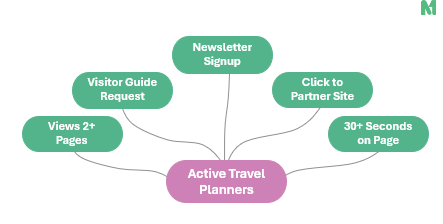 By shifting optimization toward post-click engagement, we consistently see:
If your digital marketing still revolves around CTR, it may be time to rethink how you’re defining success. While clicks are easy to buy, engaged travelers are not.
MediaOne’s engagement-first approach helps modernize measurement, sharpen strategy, and align campaigns with real traveler behavior. This approach gives destination marketers confidence that their media dollars are attracting travelers who are genuinely interested—not just people who clicked and left.
Want to learn more? Get in touch and we can help you modernize your approach to digital marketing.
Isn’t click-through rate the standard way to measure programmatic success?
CTR is a basic metric some use, but most of the larger, more sophisticated agencies use engagement with some other advanced metrics depending on the industry.
If CTR is high, doesn’t that mean people are interested?
Not necessarily. Clicks can be accidental, bots, or kids with their parent’s phones. That’s why measuring post-click engagement is so important.
Why do platforms and agencies still optimize toward clicks if they’re so flawed?
Clicks aren’t inherently flawed; clicks with low engagement are the problem. If someone clicks but doesn’t stay on your website, it’s not nearly as good as someone that clicks and reads a page or two over a few minutes.
What’s wrong with driving traffic to the homepage?
Your destination has many things to offer and travel researchers have different interests. So reaching people with 1 general creative and landing them on the homepage to try and find your assets typically hurts engagement.
If we stop prioritizing CTR, how do we know media is actually working?
Monitoring the campaigns using GA4 and server-side tracking for engagement metrics truly shows if your campaign is working along with other potential metrics like tracking foot traffic or credit card spend.
What post-click behaviors actually indicate travel intent?
These could vary depending on the DMO’s website, but typically we look at over 1 minute sessions, clicks off site to partners, visitor guide or e-newsletter signups, watching a video with some other custom metrics dependent on what the website’s goals are capable of.
What is an engaged session in GA4?
An engaged session in GA4 is a session that lasts longer than 10 seconds, includes at least one conversion event, or has two or more page or screen views. It’s Google’s way of identifying visits that show meaningful interaction instead of quick exits.
How is engagement rate different from bounce rate?
Engagement rate is the percentage of sessions that qualify as engaged under GA4’s rules. Bounce rate is simply the inverse - the percentage of sessions that were not engaged. Unlike Universal Analytics, GA4 doesn’t define bounce as “one pageview”; it’s based on time and activity instead.
What is a good engagement rate benchmark for DMOs?
There’s no universal benchmark, but many destination marketing websites fall somewhere between 50–70% engagement rate. That said, the more important question isn’t the percentage - it’s whether engaged sessions include high-intent behaviors like itinerary views, lodging page visits, or outbound booking clicks.
.png)
1 min read
Josh Sherwood : Apr 7, 2026 9:37:39 AM
.png)
1 min read
Josh Sherwood : Mar 26, 2026 1:15:15 PM
.png)
1 min read
Josh Sherwood : Mar 3, 2026 3:58:39 PM