 Josh Sherwood
1 min read
How Search Marketing Can Drive Demand for Tourism Organizations
 Josh Sherwood : Apr 7, 2026 9:37:39 AM
.png)
Travel planning rarely follows a straight path. People explore, compare, revisit ideas, and narrow options gradually.
Research from MediaOne shows that deeply engaged visitors on DMO websites are often planning travel within the next three months, with 80 percent likely visiting either to that destination or a nearby competitor. However, some media buyers fall into the pattern of optimizing campaigns toward a single key performance indicator like click-through rate, or have moved to a metric like engaged sessions which can be manipulated. This misses important context and can lead to campaigns targeting people who have already made a destination decision.
That’s why we put in the work to understand which behaviors signal a user is in the process of choosing the destination for their next trip, and built the Tourism Algorithm. With the right signals in place our marketing strategy to target planners actively in the consideration phase. Traffic quality increases, and campaigns become more effective over time because they mirror how travelers actually make decisions.
Many agencies rely on a simplified optimization model built around a small set of signals:
One primary conversion event such as a click, landing page view, or basic site visit
Metrics already built into reporting platforms such as CTR or GA4’s default “engaged sessions.” For example, GA4 uses a default 10-second timer, while we use at least 30 seconds.
Media platforms optimized toward the fastest and easiest outcome
Success measured through efficiency metrics that favor volume over quality
Limited connection between on-site behavior and future media decisions
In this structure, campaign optimization focuses which actions are easiest to generate, rather than which behaviors indicate genuine interest. The result can be misleading: traffic increases, yet visits are often brief and engagement remains shallow. Over time, campaigns optimized for these signals prioritize speed and cost, rather than sustained interest.
Campaigns may look efficient on paper, but the real impact they deliver is limited.
MediaOne leverages engagement signals in a different way to drive real economic impact for communities. Instead of treating every interaction with the same weight, our Tourism Algorithm shifts focus to the sequence of behaviors that reveal genuine intent. Time spent exploring, multiple pages viewed, and deeper site actions all signal a traveler who is seriously considering a destination.
At the center of the approach is a hierarchy of engagement signals. By ranking engagement signals on a sliding scale, the Tourism Algorithm allows our digital performance team to learn which audiences are actively researching and evaluating destinations. We evaluate post-click behavior from users who interact with media campaigns. Actions such as newsletter signups, visitor guide requests, viewing multiple pages, clicking to partner websites, or spending meaningful time on the site are tracked and assigned weighted values based on their importance.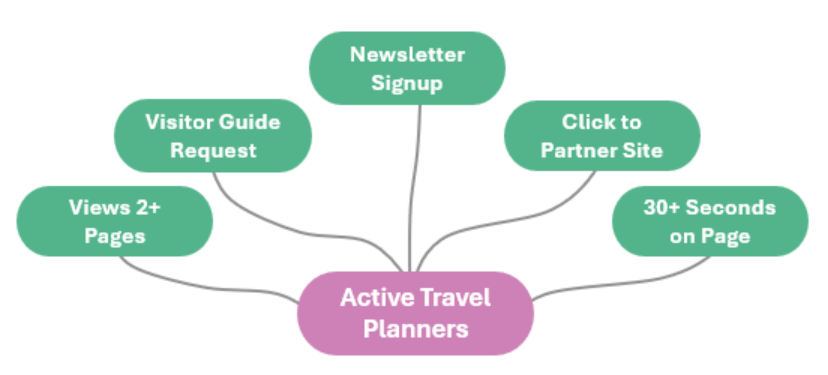
Visitor behavior continues informing campaign optimization after the click. As our team gathers data, the Tourism Algorithm begins prioritizing audiences who demonstrate stronger engagement signals such as video completion, longer visit duration, and deeper site exploration. This empowers our team to drive improved audience quality as the campaign matures, because our campaigns increasingly reach travelers who are actively looking for trips that match the in-market visitor experience.
These richer behavioral signals give our Tourism Algorithm clearer direction, creating a feedback loop that allows our team to continually optimize campaign strategy and drive more meaningful engagement over time.
Basic optimization strategies that only prioritize for CTR or simple “engaged visits” in Google Analytics can lack transparency and sometimes drive low-intent traffic. When destinations move from traditional optimization to MediaOne’s Tourism Algorithm, they have seen their campaign average engagement time increase as much as 135 percent.
Common improvements also include:
Higher average engagement time
More outbound clicks to partner websites, signaling interest in local businesses
Higher rates of visitors spending more than one minute on the destination website
Increased completion of campaign-specific goals such as event ticket sales
Additional patterns often emerge as campaigns using the Tourism Algorithm approach mature:
Increased non-bounce traffic and deeper site exploration
Stronger downstream actions such as visitor guide signups, email subscriptions, and partner referrals
Campaign performance that improves steadily rather than plateauing early
The Tourism Algorithm nurtures smarter campaigns that outperform other strategies by identifying travelers who are exploring, comparing options, and moving closer to a decision. And most importantly, media dollars reach travelers who are actively researching and are more likely to become visitors to the destination.
What metrics actually matter for engagement campaigns?
Metrics that reflect active travel research matter most. These include time spent on site, multiple pages viewed, depth of exploration, video completion, outbound clicks to partner websites, and completion of high‑intent actions such as newsletter signups or visitor guide requests.
How do I measure campaign success without conversions?
Campaign success can be measured through post‑click behavior. Improvements in average engagement time, non‑bounce sessions, repeat page views, and downstream actions indicate higher‑quality traffic, even when users are still in the research phase.
What is a good engagement rate for my industry?
There is no single engagement benchmark that applies to all destinations or campaigns. Engagement should be evaluated against historical performance and tracked for sustained improvement over time. Industry benchmarks such as CTR can provide context but should not replace destination‑specific baselines.
How long should an engagement campaign run before judging results?
Engagement campaigns should run for at least three months before evaluation. This allows time for initial learning, optimization based on engagement signals, and measurement of post‑optimization performance as the algorithm improves.
.png)
1 min read
Josh Sherwood : Apr 7, 2026 9:37:39 AM

1 min read
Josh Sherwood : Apr 14, 2026 12:02:44 PM
.png)
1 min read
Josh Sherwood : Apr 2, 2026 10:51:36 AM