 Clint Lawing

The better your local businesses are at content, the better your whole destination does. When every inn, restaurant, outfitter, museum and nonprofit tells its own story well, AI has more experiences to recommend, and travelers find more reasons to choose your destination and come back. Casting the wider net of everything there is to do helps everyone win.
Travelers have stopped typing "beach rental oceanfront 4 bedroom." They ask an AI assistant for "a 4-day uncrowded beach trip for tired parents and a toddler: quiet soundside beach, easy sunset kayak launch, local steamed shrimp." The assistant answers with one to three picks, and the trip gets built around them.
That's the shift this guide unpacks. Below: how travelers ask now, how fast AI planning is growing, and five plays any lodging, attraction, restaurant or nonprofit can run to become one of those picks.
Prompts ask for feelings, not specs
A search bar filters commodity specs, so everyone who matches looks the same. An AI prompt describes human context, and only the places that tell that story match it.
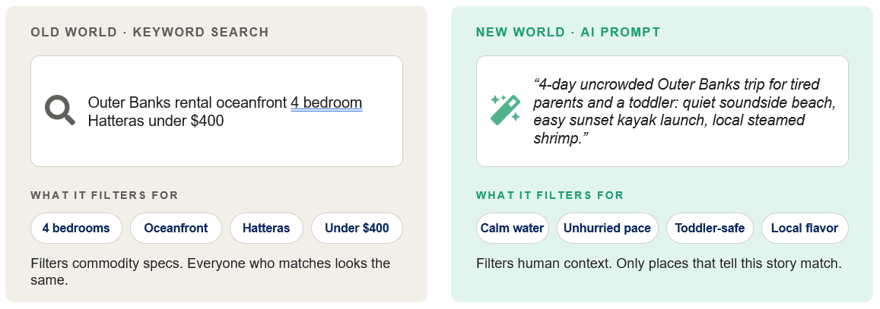
If your listing only lists specs, you can't be the answer to that prompt. Your marketing has to answer the feeling, not just the filter.
AI shrinks the shortlist to 1–3 picks
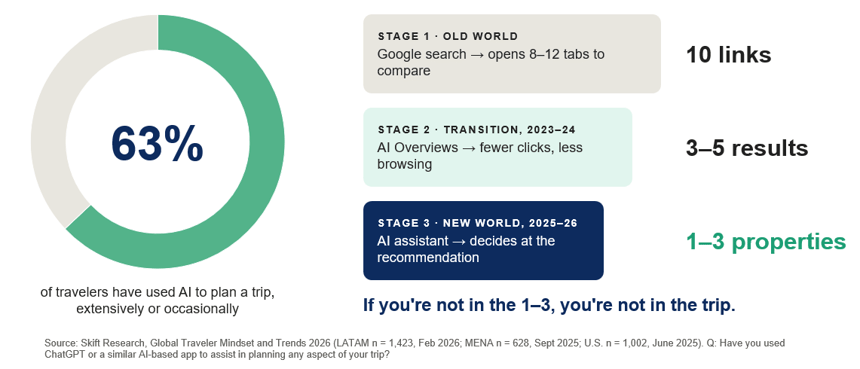
63% of travelers have already used ChatGPT or a similar AI app to plan a trip, extensively or occasionally. As AI takes over the asking, the number of places a traveler actually considers keeps falling.
How the travel shortlist narrowed · 3 stages
There's no page two anymore. A traveler who once opened a dozen tabs now gets a short recommendation and decides right there.
Experiences now come first
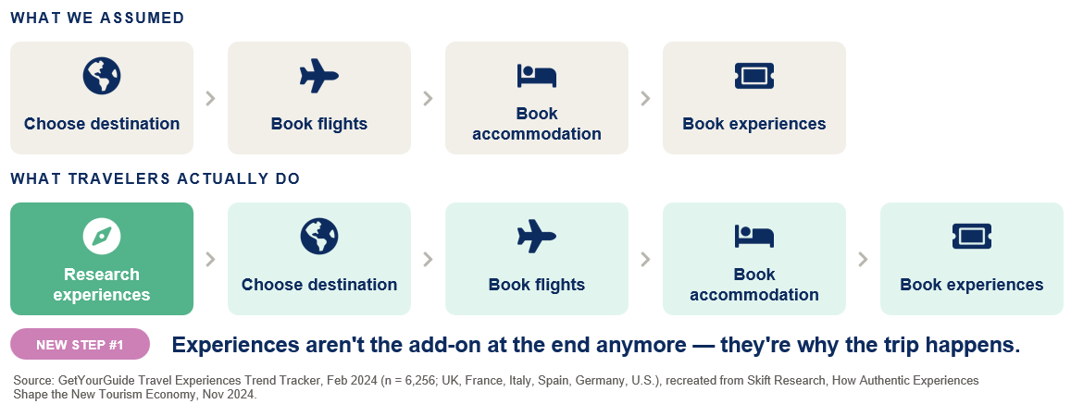
We used to think travelers picked a destination, booked a flight and a room, and only then figured out what to do. Now they research the experience first, then choose the destination that delivers it.
Trip-planning order, assumed vs actual · GetYourGuide Travel Experiences Trend Tracker, Feb 2024
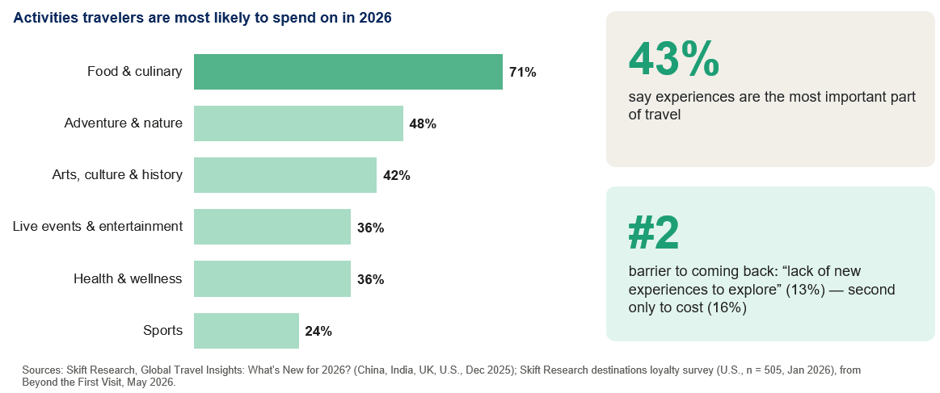
That makes your activities, rituals and local flavor the top of the funnel, not the add-on at the end. 43% of travelers say experiences are the most important part of travel, and food tops the list of what they plan to spend on.
Experiences Drive Repeat Visitors Too
Experiences drive the return trip too. The #2 reason travelers don't come back is a "lack of new experiences to explore" (13%), second only to cost (16%).
AI trip planning is growing fast
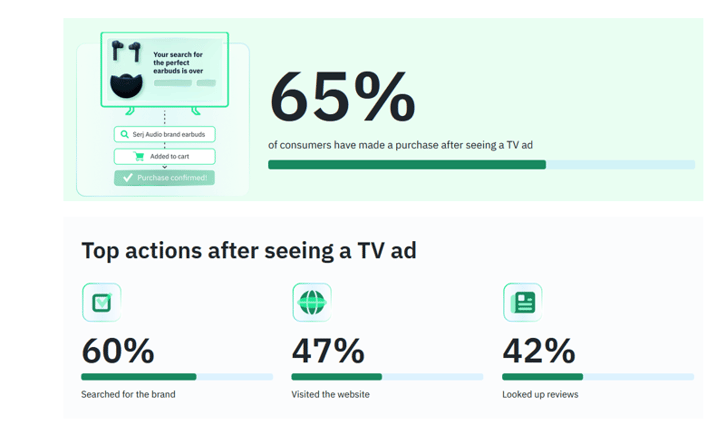
65% of consumers have made a purchase after seeing a TV ad and 60% went and searched for the brand first.
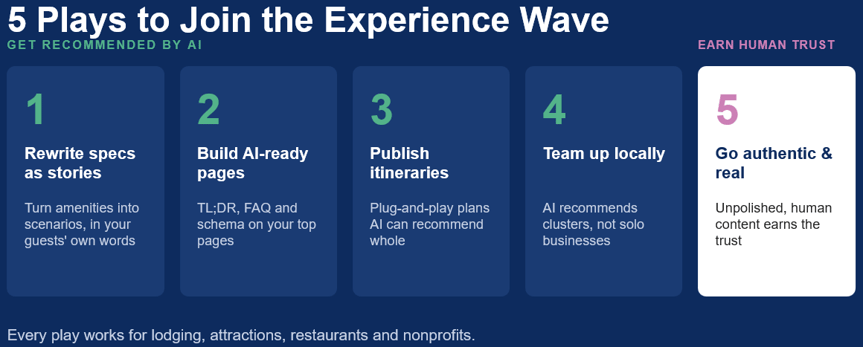
Practical Playbook: Five plays to join the experience wave
Every one of these works for property managers, hotels, attractions, restaurants and nonprofits.
Play 1: Rewrite specs as stories
Take your top amenities and rewrite them as the moment they create.
The best words are already in your reviews:
- Find the unscripted truth. Guests never praise granite counters. They praise coffee on the deck watching dolphins.
- Harvest the vibe words. Uncrowded, peaceful breeze, restorative, nostalgic, hidden gem.
- Seed them everywhere. Headlines, listing summaries and your Google Business Profile.
- A TL;DR summary up top. Three bullets above the fold: who it's for, how it feels, why it's different. It's the easiest thing for AI to quote.
- A natural-language FAQ. Answer real prompts: "Is the sound calm enough for toddlers?" "Can we launch paddleboards from the yard?"
- Matching schema markup. Back the page with JSON-LD (FAQPage, LodgingBusiness, amenityFeature) so AI can't misread who you are.
Play 2: Build AI-ready pages
AI likes structure. Your pages need to have many of the usual elements like header tags, images with alt tags and more. What's new? Include TL;DR's, index and FAQs.
Play 3: Publish plug-and-play itineraries
AI loves a complete answer it can recommend whole. Write each itinerary like the prompt it answers: who it's for, how long, how it should feel. Then link every stop to a local partner.
Play 4: Team up locally
Nobody prompts for "a rental." They prompt for a trip: somewhere to stay, somewhere to savor, something to explore. AI answers with clusters of businesses that show up together across the web, so your neighbors aren't your competition here. They're your co-signers.
- Cross-link partners on every itinerary and scenario page.
- Package a Stay + Savor + Explore bundle with two neighbors.
- Get mentioned on each other's pages, and on your DMO's.
- On camera: shoot vertical on a phone with no crew or script; post real moments like sunrise check-ins, windy days and behind the scenes; put staff on camera sharing favorite local spots; repost guest content (with permission) and reply in your own voice.
- At every touchpoint: add staff insider picks to confirmation emails; try "Ask me my favorite secret spot" nametags; create signature rituals like fire-pit s'mores or a 4 PM local tasting; set aside a small budget for spontaneous guest delight, and share the story.
Play 5: Go authentic and real – No polish needed
Once AI sends someone your way, they want proof you're real. Attention lives in short-form social: marketers rank short-form video as the format with the biggest ROI (49%), well ahead of long-form video (29%). And feeds are now full of AI-polished imagery that people can feel.
Consumers are 2.4x more likely to see user-generated content as authentic than brand content, 98% say authentic images and video are pivotal to trust, and 92% trust recommendations from people they know over any advertising. When anyone can generate a perfect photo, imperfect proof is what people trust.
Turn staff and guests into storytellers:
Every ritual is a story hook, and every story hook is tomorrow's post.
Sources: HubSpot, 2026 State of Marketing Report; Stackla, Consumer Content Report (2019); Getty Images VisualGPS, Building Trust in the Age of AI (2024); Nielsen, Global Trust in Advertising.
Your Monday morning mandate
Stop selling square footage. Start selling stories. Here's the whole plan, and it fits in one week:
Stop selling square footage. Start selling stories. Here's the whole plan, and it fits in one week:
- ☐ Monday: mine your reviews and rewrite 3 listings as scenarios.
- ☐ Wednesday: add a TL;DR summary and FAQ schema to your top page.
- ☐ Friday: call 2 neighbors and build a shared itinerary.
- ☐ Every day: post one raw, phone-shot moment.
FAQs
How are travelers using AI to plan trips?
About 1 in 5 consumers already use gen AI for trip planning, and 30% of Americans say they’ll use it in 2026. Their top uses are finding activities and restaurants (66%), destinations (56%) and itineraries (55%).
Why does AI change how local businesses should market themselves?
AI prompts describe feelings and situations, like “uncrowded” or “easy with a toddler.” AI then recommends only a few businesses that clearly match that story. If your listing only lists amenities, it can’t match those prompts.
What does “selling stories” mean for a small business?
It means describing the moment an amenity creates instead of the amenity itself. “Full kitchen” becomes “cast-iron skillets and local coffee for unhurried weekend mornings.” The best language usually comes straight from your guest reviews.
What makes a web page “AI-ready”?
Three things:
- A short TL;DR summary at the top.
- A FAQ that answers real traveler questions.
- Schema markup (JSON-LD) so AI reads your business correctly.
Why should businesses partner with competitors or neighbors?
Travelers ask AI for whole trips: somewhere to stay, eat and explore. AI recommends businesses that show up together across the web. Cross-linking and shared itineraries make you part of that cluster.
Does marketing content need to be professionally produced?
No. Phone-shot, unpolished content featuring real staff and guests often builds more trust than polished ads. Consumers are 2.4x more likely to see user-generated content as authentic, and 98% say authentic visuals are key to trust.
Where should a business start?
Start with one week:
- Rewrite three listings using words from your reviews.
- Add a summary and FAQ to your top page.
- Build a shared itinerary with two neighbors.
- Post one real moment every day.